





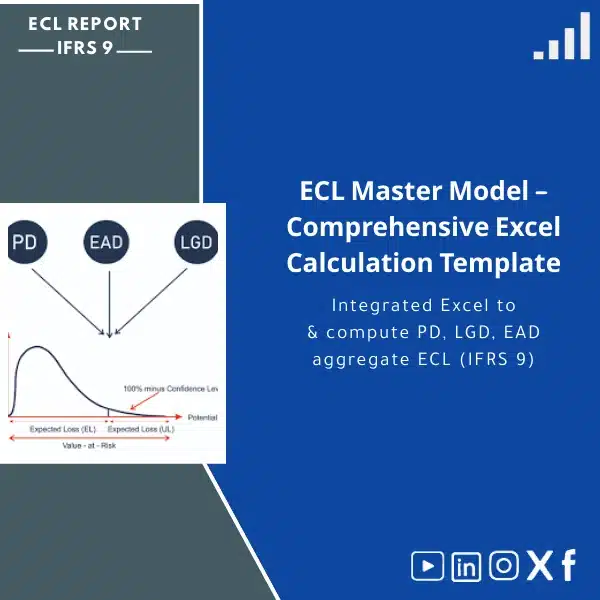
ECL Master Model – Comprehensive Excel Calculation Template
Original price was: 599. 499Current price is: 499.
Integrated Excel solution to compute PD, LGD, EAD and aggregate Expected Credit Loss (ECL) under IFRS 9.
Ready-made calculations, disclosure tables and audit-friendly workings to accelerate quarter-end provisioning,
regulatory filings and internal risk reporting.
Key benefits & value of the ECL master model
The ECL Master Model is engineered to remove common frictions in IFRS 9 provisioning: long model build cycles,
opaque calculations and repetitive disclosure assembly. It translates technical features into tangible benefits:
Save time and reduce cost
Pre-built PD/LGD/EAD modules and automated aggregation reduce manual preparation time for month/quarter-end
provisioning — typically cutting efforts by weeks compared with building from scratch.
Ensure compliance and auditability
Every calculation is visible with formula-level transparency and linked assumptions. Exportable audit sheets
and version logs simplify regulator and auditor reviews.
Flexible but rigorous
Use your internal scoring outputs, statistical PD curves, or simple cohort default rates. Scenario management
and weighting options support forward-looking macro adjustments required by IFRS 9.
Use cases & real-life scenarios
How teams use the ECL Excel model in practice:
- Bank month-end provisioning: Roll forward exposures, compute stage migrations and produce consolidated ECL for the balance sheet.
- Regulatory submission: Produce disclosure tables and reconciliations required by auditors and supervisors.
- Acquisitions and portfolio review: Rapid stress-testing of ECL under alternate PD/LGD assumptions before purchase decisions.
- Model validation: Keep calculational transparency for validation teams while allowing sensitivity testing and back-testing inputs.
- Limited-data environments: Use modular inputs to compute conservative full provision models where historical data is partial.
Who is this product for?
This ECL master model is designed for financial institutions and companies applying IFRS 9 that require accurate, compliant and auditable ECL calculations. Typical users include:
- Retail, corporate and SME credit teams in banks
- Finance and accounting teams preparing IFRS 9 disclosures
- Risk modelers and validators
- Finance teams at leasing, consumer finance and insurance companies
If your organisation needs a reliable IFRS 9 ECL template that handles PD, LGD and EAD calculations with clear outputs for finance and audit, this model addresses those needs directly.
How to choose the right configuration
We offer a modular Excel workbook. Select the configuration that matches your data maturity and reporting requirements:
- Starter: For limited historical data — cohort-based PDs, fixed LGD assumptions, basic disclosures.
- Standard: Full PD curve support, exposure segmentation, scenario weighting and disclosure templates.
- Advanced: Scorecard integration, lifetime ECL automation, sensitivity tables and custom reporting modules.
Choose Starter to get immediate outputs with conservative assumptions; upgrade to Standard or Advanced as data quality and regulatory needs grow.
Quick comparison with typical alternatives
When deciding between solutions, consider these trade-offs:
- Home-built spreadsheets: Low initial cost but high long-term risk (errors, poor audit trails). The ECL master model provides a vetted structure and audit-ready outputs.
- Large software platforms: Powerful but costly and slow to implement. Our Excel template is faster to deploy and easier to customise for common IFRS 9 tasks.
- Consultancy reports: One-off accuracy but not reusable. The template is reusable, transparent and designed for in-house control.
Best practices & tips to maximise value
- Start with a data quality assessment; map available fields to required inputs (exposure, vintage, PD source, collateral).
- Document assumptions in the provided assumptions sheet — auditors expect clear links between assumptions and outputs.
- Run sensitivity and scenario tests every cycle to show management the impact of macro changes on ECL.
- Keep a version log and use the model’s exportable audit sheets during review cycles.
- Use modular deployment: implement core provisioning quickly, then add advanced modules for scorecard integration or lifetime ECL automation.
Common mistakes when buying/using similar models — and how to avoid them
- Buying the most complex option first: Leads to delays. Choose the module that matches current data and processes.
- Hiding formulas: Lack of transparency causes audit friction. Our template keeps formulas visible and documented.
- Using inappropriate LGD assumptions: Validate and document LGD inputs rather than copying default percentages.
- Ignoring staging rules: Ensure you apply the 3-stage model correctly — the template flags probable misclassifications.
Product specifications
- File type: Microsoft Excel workbook (.xlsx) — no macros required (optional macro-enabled version available).
- Modules included: PD module, LGD module, EAD calculator, Stage classification (3-stage), Scenario manager, Disclosure tables.
- Sheets: Input staging, assumptions, calculation engine, output summaries, audit trails, exportable disclosures.
- Compatibility: Excel 2016+ (Windows & Mac) and Office 365; CSV import templates for bulk data.
- Deliverables: Downloadable Excel file, user guide (PDF), example dataset, and one month of email support for customization questions.
- Customisation: Template can be adapted to portfolio segmentation, currencies, and local regulatory notes on request.
Frequently asked questions
Is the ECL Master Model fully IFRS 9 compliant?
Yes. The workbook implements the key IFRS 9 requirements: 3-stage classification, 12-month vs lifetime ECL, forward-looking adjustments and disclosure tables aligned with typical regulatory expectations. It is delivered with documentation and audit sheets to support compliance reviews.
What data do we need to run the model?
Minimum inputs include exposure balances, contractual terms (maturity), observed defaults or PDs, and collateral/LGD assumptions. The Starter configuration supports limited historical data; Standard/Advanced support richer inputs such as scorecard outputs and macro overlays.
Can we customise formulas or integrate internal scorecards?
Yes. All formulas are visible and editable. The template includes guidance for integrating scorecard outputs (PDs) and mapping them into the calculation engine. For deeper integration, we offer paid customization support.
How is support provided after purchase?
Every purchase includes a user guide and one month of email support to assist with installation, configuration and initial runs. Paid support packages are available for bespoke customisation and on-site workshops.
Ready to stop building from scratch?
Accelerate your IFRS 9 provisioning with a transparent, audit-ready ECL Excel model. Deploy quickly, reduce audit friction,
and produce disclosure-ready outputs each reporting period.
Need help picking the right configuration? Contact our support after purchase or consult the included user guide.
Only logged in customers who have purchased this product may leave a review.


Reviews
Clear filtersThere are no reviews yet.